by Stefani Ruper | Aug 11, 2016 | Blog, Hypothalamic Amenorrhea |
One of the most common questions I get in emails, on social media and here on the blog is how to overcome hypothalamic amenorrhea.
Most specifically, women want to know: how do you eat for hypothalamic amenorrhea? how much do you eat for hypothalamic amenorrhea? When do you eat for hypothalamic amenorrhea?
Hypothalamic amenorrhea, given that it’s the condition of having starved (intentionally or not) your body into a state of infertility with low calorie diets, fasting, or excessive exercise, requires a lot of nourishment and care.
I personally have done it. (And overcome PCOS at the same time, too.) I have coached countless women through it.
And you can do it, too.
Here’s how:
Eat for Hypothalamic Amenorrhea: The General Principle
First and foremost, you need to eat.
Normally, our culture tells people to “eat less, exercise more.”
For hypothalamic amenorrhea, usually the problem however is that you have followed this advice. So now you have to reverse it.
You have to eat more, and exercise less. You have to relax. You have to give your body the nourishment (in the form of calories) it needs in order to consider itself well-fed. You have to reverse the damage done to your hormone signalling mechanisms from months, years, or even decades of under-feeding yourself.
You have to focus on your health, wellness, fertility, happiness, and activities rather than on the specific size of your body.
You have to learn to accept your body as a soft animal, and let it be the size that it wants to be.
Work on appreciating your body for what it does, not for what it looks like. (I know it is easier said than done – here is a great place to start, or here).
Then nourish yourself to high heaven, focusing on eating more, eating plenty, eating bountifully.
Here are the primary pieces of advice I give to all women I encounter with HA:
Eat for Hypothalamic Amenorrhea: Specifics
1. Eat more
You are probably used to eating at least half of what you should be. So eat more. A lot more.
Shoot for at minimum 2000 calories a day. If you are active, make it 2500. Julia Ross says that she believes all women should eat 2300 calories a day.
I don’t recommend counting calories precisely – but it can be important for a lot of people starting out with eating more to keep at least ballpark figures in mind in order to make sure you eat enough.
2. Eat when you’re hungry
Do not go hungry. Whenever your body detects hunger signalling hormones, it decreases thyroid and sex hormone production. In order to properly produce these hormones and get your fertility, sex drive, clear skin, and strong bones back, eat whenever you feel hungry.
3. Don’t stop eating until you’re reasonably full
Many people who suffer from hypothalamic amenorrhea eat regularly but always try to stop themselves from reaching a state of fullness. This ridiculously just deprives your body of good satiation hormones it needs to get “fed” signals. It also sets you up for more hunger faster.
4. When in doubt, eat more rather than less
If you don’t know if you’ve eaten enough, go ahead and eat more. There is nothing to fear – in terms of your health – from eating more food, especially if it’s nice, healthy whole foods. There is a chance you might gain a few pounds, especially if you are under your body’s currently desired set point due to your previous behaviors. But this will not be a bad thing. This will be a good thing because it means reassuring your body it is being fed.
5. Eat when you wake up
While you are sleeping, technically you are fasting.
After dinner and a full night’s rest, you have probably gone 8-14 hours without food.
You might wake up and not be hungry, but that is probably because you have conditioned yourself out of it. So eat when you wake up. Even if it’s just one or two hundred calories, that’ll be enough to break your fast and let your body know that today you are going to eat.
(Also: feel free to eat right before bed!)
6. Forget “3 square meals”
In paleo and other health spheres online, you will often hear people say that you should only eat in 3 square – or even 2 square – meals a day.
They say – don’t graze.
But here’s the thing:
Everybody has a different cure.
For someone dealing with diabetes, eating in meals could help them manage their blood sugar and insulin levels.
But you do not have diabetes.
You have hypothalamic amenorrhea. What works for someone else is not necessarily what works for you. What cures someone else is not necessarily what cures you.
The answer for them is to eat in meals. Your answer is to eat when you are hungry. And if you want to – you can eat all day long. Eat in six small-moderate sized meals if you like. Or eat in 5. Or just simply snack all day, if that’s what you feel like.
The point of eating to overcome hypothalamic amenorrhea is to eat, and to eat bountifully, and to assure your body that you are fed. Restricting yourself to three square meals a day is not the right course of action for you.
Of course, if you still want to eat in three square meals a day, you are more than welcome to. Just make sure that you still hit your 2000 or 2500 calorie minimum, and that you never force yourself to feel hunger between the meals.
7. Get all the macronutrients
Don’t be low carb.
Don’t be low fat.
Eat plenty of both. Your body needs fat to manufacture hormones; it needs carbohydrates to feel good and fed, as well as to produce thyroid hormone.
I recommend starting with 150 grams of carbohydrate a day for overcoming hypothalamic amenorrhea.
Start also with 50 grams of fat.
Get at least 50 grams of protein.
Now of course you’ll notice that adding up 50 grams of protein, 150 grams of carbohydrate, and 50 grams of fat is still much less than 2000 or 2500 calories. This is true. I am not saying that you should eat these amounts, but that they should be your absolute minimum for that particular macronutrient. If you don’t like fat all that much, just make sure you eat at least 50 grams, then fill up the rest of your diet with carbs. If you are the opposite and don’t like carbs all that much, make sure you still get at least 150 grams and fill up the rest of your diet with fat.
Set macronutrient minimums, not maximums.
8. Focus on quantity, not quality
Now, this is the exact opposite of advice I normally give people when they are trying to be healthy.
One of my favorite things to say is that people need to focus on the quality of their food, and care less about the quantity.
In general, this is great advice. High quality food is super important for being healthy in the long run.
But for overcoming hypothalamic amenorrhea, what you actually need more than anything is calories.
So, yes, if you decide to eat all 2500 calories a day in the form of vegetables and fruits and other paleo delights, you are more than welcome to.
But if you focus on being nourishing and then add in some hyper-caloric foods on top of that – like paleo desserts, or simply regular desserts, go right ahead.
I personally got my period back when I added chocolate and oat cereal to my diet. A good friend of mine got hers back when she was going through a period of anxiety and ate a lot of candy. No joke. What your body needs is energy. Quality is important, but you have got to make sure you get the quantity you need. Do what you need to to make that happen.
Beyond food: Overcoming hypothalamic amenorrhea
Bonus point 9. Exercise less
Exercise less. A lot less. If you have cut back on exercise and still haven’t seen results, keep cutting back. Just a couple work outs a week (and not 90 minutes in a spin class) and some gentle walking or yoga is a great way to go. Don’t make yourself work out if you don’t have the energy, and don’t stress your already tired body.
What your body needs now is gentleness. Let it be gentle.
Here is a list of indicators you may be over-exercising.
10. Don’t nitpick your weight
When women are overcoming hypothalamic amenorrhea, they almost inevitably express concern to me about their weight.
They say – “I know I might have to gain weight, but how much?” “Will I have to go back to how heavy I was before?” “Will I become heavier than I was before?”
The thing is – the relationship between weight and hypothalamic amenorrhea is different for everybody. Some gradually gain a little bit of weight until they start to menstruate. Some don’t gain weight but simply benefit from eating more calories. Some people swing up high in weight and then come back down. Others swing up higher in weight then don’t come back down.
It varies.
So the only advice I can give you, if you really care about your period, your fertility, your sex drive, your strong bones, your clear skin, your good sleep, and your improved calm and mental health, is to learn to be okay with a bigger, squishier body.
I did. You can read a bit about my journey in this post here on being sexy while gaining weight, this one here on our lack of objectivity about our size, this one here on the health benefits of gaining weight for me, or in this book – in which I also give my best advice for body acceptance – here.
So that’s my advice on how to eat for hypothalamic amenorrhea.
Soon I will release a meal plan for those of you who would like more guidance. In the meantime, simply follow these ten guidelines. More food, at more of the time, with more relaxing. It’s simple – but it truly is the trick to eating to overcome hypothalamic amenorrhea.
For more on HA, see my posts Signs and Symptoms of Hypothalamic Amenorrhea, Overcoming Hypothalamic Amenorrhea, and Hypothalamic Amenorrhea Treatment.
Also, if you happen to be one of the 15% of American women who has PCOS – or maybe you have hypothalamic amenorrhea but also don’t quite fit the bill – check out this post on how you can have PCOS and hypothalamic amenorrhea at the same time.
by Stefani Ruper | Jul 2, 2015 | Hormones, Hypothalamic Amenorrhea |
There are many different problems that can cause women to stop menstruating. In rare cases amenorrhea comes from genetic defects and physical abnormalities. These cases usually require medical intervention.
More commonly, women stop menstruating due to conditions like PCOS or hypothalamic amenorrhea, both of which are highly influenced by (and overcome with) diet and lifestyle choices.
Because there are so many possible causes of amenorrhea, the most important thing you can do to overcome a problem with your fertility is to investigate.
Figuring out your problem is the first step towards solving it.
If you once had normal menstrual cycles but now do not, there is a very good chance that some underlying health problem is the culprit. PCOS, like I mentioned, is one potential culprit. Another potential and common culprit is hypothalamic amenorrhea.
In this post I discuss hypothalalmic amenorrhea symptoms and causes. This will help provide a road map for your healing – and will hopefully help you get moving in the right direction.
What is hypothalamic amenorrhea?
Hypothalamic amenorrhea is the technical name for when the hypothalamus stops sending “go ahead and reproduce” signals to the pituitary gland. This results in menstrual cycles being lost, along with other symptoms.
The primary hormone used for this signalling process is GnRH (gonadotropin releasing hormone). The hormones that the pituitary gland would then ordinarily produce but in hypothalamic amenorrhea fails to do so are LH (luteinizing hormone), FSH (follicle-stimulating hormone), and prolactin. Hormone levels that then fall as a result of those hormone levels falling are estrogen, progesterone, and testosterone (usually – though sometimes some of these may stay elevated for complicated reasons).
I like to think of the system a set of dominoes: hormones are produced in a cascade. If there is no agent (the hypothalamus) that knocks down the first domino at the beginning of the process, then none of the dominoes (hormones) get knocked down. Hormones do not get made if the hypothalamus does not tell the pituitary gland to make them.
A staggering 10% of American women suffer from hypothalamic amenorrhea at some point in their lives. And interestingly enough, hypothalamic amenorrhea is not confined to humans! Other primates also experience impaired fertility and lose their menstrual cycles due to hypothalamic dysfunction.
Hypothalamic Amenorrhea Symptoms
There are many symptoms of hypothalamic amenorrhea. These are the most common:
-Loss of menstrual cycles, or sometimes very light bleeding
-Failure to ovulate
-Low libido
-Sleep disturbances
-Depression, anxiety, or other chronic mood symptoms
-Cystic acne (occasionally, especially when you simultaneously have PCOS)
-Low energy
-Constant hunger, or changes to hunger cues
-Always feeling cold
-Other symptoms of hypothyroidism, which often accompanies hypothalamic amenorrhea, such as brittle hair and nails
These are problems that are a result of hypothalamic amenorrhea. There are many other signs that may indicate or even cause hypothalamic amenorrhea. They are:
-Low body fat percentage
-Rapid weight loss
-Excessive exercise (different for every woman – challenging workouts 1 or more times a day is generally a good, rough guideline for too much)
-Stress
-Low fat diet
-Low carbohydrate diet
-Low calorie diet
Causes of hypothalamic amenorrhea
There is a common theme to the “signs” of hypothalamic amneorrhea I listed above:
each of them are a threat to a healthy pregnancy.
The science of this takes us back millions of years.
Way back in human history, when people hunted and gathered on the savannah, it was very important to be in a safe environment while pregnant. Famine could very easily kill a pregnant woman. Starving could very easily kill a pregnant woman. A stressful circumstance like war or a long hike could also be too much for a pregnant woman to bear.
Any sign of an “unsafe” condition on the savannah was life-threatening to a pregnant woman. In order to prevent pregnancy at an unsafe time, the female body developed a very keen sensitivity to starvation signals.
When the body detects “starvation,” it shuts down reproductive function. This prevents you from becoming pregnant while stressed – something which might very well have killed you on the savannah.
Having inadequate food, losing a lot of body weight, exercising a lot, having a low body fat percentage, eating too little fat or too few carbohydrates, or being under extreme emotional duress are all important starvation signals.
When we mimic these life-threatening savannah conditions in the modern world – and we do this so often by starving ourselves for the sake of diets, slenderness, or for atheltic goals – our bodies respond with the old programming of hormonal shut-down.
Hypothalamic amenorrhea special case: birth control pills
One final yet important thing to discuss about hypothalamic amenorrhea is what happens when women come off of birth control pills. Sometimes, women do so without any problems. Yet quite frequently when women come off of birth control they stop menstruating.
The reason this happens is two-fold: 1) while on the pill, the liver is responsible for filtering out “old” hormones. Sometimes hormone surplus builds up in the liver, such that when you come off of the pill the body still feels like it’s on it because the hormones are being released into the bloodstream by the liver.
2) The body does its best to maintain stable hormone levels throughout time. While on the pill, hormones enter the body from the outside. This means the pituitary gland doesn’t have to work as hard as it used to. Then, when coming off of the pill, the pituitary gland is still “lazy” and takes some time to kick back into gear.
Sometimes this problem of being infertile coming off of the pill takes several months if not a year or two to overcome. Sometimes it is primarily a hypothalamic amenorrhea-type problem – other times it is more like PCOS.
In all cases, a nutrient-rich diet full of organic vegetables and fruits, organ meats (here’s a supplement in case you do not like to eat liver), eggs, fermented foods (here are my favorites) and the rockstar superfood cod liver oil that focuses on eating more rather than less will almost always greatly accelerate healing.
I also happened to write a guide on birth control options and how to be as healthy as possible while using them (or not) – which you can read about and download here.
Hypothalamic Amenorrhea Symptoms: What to do about them
The solution to hypothalamic amenorrhea is simultaneously complex and simple. It is complex because every woman is unique and must meet her own specific needs. It is simple because it very often boils down to two very simple principles:
Eat.
Relax.
Repeat.
In hypothalamic amenorrhea, women suffer because their bodies want love. They want nourishment. They want reassurance. They want to feel safe and to feel fed. I talk about this in more detail in this post – but really most of all what it all boils down to is eating and love and eating and love.
And that is it for hypothalamic amenorrhea symptoms and causes. What do you think? What are your hypothalamic amenorrhea symptoms? What caused your hypothalamic amenorrhea? Then head on over to this post and tell me all about your progress on your journey overcoming it!

by Stefani Ruper | Feb 13, 2014 | Blog, Body, Body Image, Disordered Eating, Feminism, Fertility, HPA axis, Hypothalamic Amenorrhea, Self-love |
Mannequins do not menstruate, and this is not just because they are made out of plastic.
Here are some images of mannequins in clothes and fully nude. I think this difference is important to pay attention to because seeing mannequins in clothes the majority of the time impairs our ability to process just how specifically manufactured they are to drape clothing just so and to go beyond all reasonable body size aspirations. We don’t regularly see what’s underneath. But what’s underneath is nothing but angles and Barbies.
Note, for example, how hip bones often jut out, which is a way to cause skirts and pants to taper and hang low and stereotypically sexy. Note also how waists are tiny. Note also how legs are longer than the list of activity on my credit card accounts. Which is to say – Long. Disproportionately so.
To which I can only say, holy crap thigh gap.
Mannequins are problematic for a lot of reasons. One of the worst is that this is a subconscious problem. We are well aware of the damage magazines and celebrities and runways and the like do to our self-love, but how often do we consciously acknowledge the power mannequins have over us?
Not very often.
Which is unfortunate – because it has been at least somewhat scientifically proven that mannequins do not have a high enough body fat percentage in order to menstruate.
Here’s how:
Two Finnish researchers, Minna Rintala and Pertti Mustajoki, tested standard accepted body fat percentages for women against measurements they made on mannequins (of arm, thigh, waist, and hip circumference are all standard means by which to measure body fat percentage) they found in Finnish museums that were from the 20s, 30s, 50s, 60s, and 90s.
Women need, on average, at least 17% body fat to begin menstruating. The researchers also use the data point of 22 % body fat for regular cycles – though I would argue that this is a statistic biased from the sample being drawn from the super industrialized nations of Western Europe and the United States. For the purposes of our investigation, however, their standards hold since we are largely of industrialized nations such as the US. Our mannequins, we should also note, are typically about 5’10 — the same size as the “fit” models on runways.
In this study, the pre-WWII mannequins had levels of body fat that were consistent with those seen in a healthy, young female of reproductive age population: up to 23 percent, at least. All the way up to 23 percent! That feels incredible – though it makes me sad to write that sentence. Women are known to be quite healthy up to and around 30 percent.
Starting in the 1950s, the estimated body fat on the mannequins decreased significantly. By the 1990s, a significant number of mannequins would not have sufficient body fat to menstruate if they were, you know, actual people. Check out the graph below. The bars detail body fat percentages for hypothetical women of “healthy” body mass indexes of 20-25. In the early decades the mannequin measurements come close, but in later decades fall far below a healthy BMI (note also that the WHO standard for “healthy” BMI goes down to 18.6..though this is contested, as in all things).
So what do we do with this knowledge?
Stop expecting clothes to look on us like they do on mannequins, I think.
And think about that maybe not even as a neutral thing, but as a good thing.
Sure, there are women out there with body types as slender and tall as mannequins with as little body fat, and perhaps naturally so. That’s great – beautiful – natural, what-have-you. I am sure some of them menstruate, especially if they live in less industrialized countries. But the majority of us plain old are not, and its a simple fact that extremely low body fat percentages result in impaired fertility, and, hey, isn’t it cool that we have enough body fat to menstruate?
And, hey, isn’t it cool that we know (more about which forthcoming in a HuffPo article by yours truly) that runway models starve themselves precisely in order to be the same size as mannequins, and that when we do the eat-sufficient-calories-healthy thing we are simply doing the human thing?
And, hey, isn’t it cool that we have lumps and jiggly parts and quirks and scars that only real human beings who love and dance and have sex and laugh can have, and not ones made out of plastic?
Mmmmmm humanity.
—
My book, Sexy by Nature, describes a whole foods approach to health, sex appeal, and confidence for real human beings.

by Stefani Ruper | Jan 21, 2014 | Blog, Body Image, Disordered Eating, Hormones, HPA axis, Hypothalamic Amenorrhea, PCOS, Self-love |
The one thing that we talk about most in this community is how to be in hormone balance. How to be fertile. How to enjoy being a woman instead of constantly fighting the basic facts of natural womanhood.
Every day I send emails to women making recommendations regarding food choices, lab tests, and self-love and body image issues. I thought it perhaps best, then, to share with you the differences I have experienced at different points in my life regarding my hormone balance.
Pre-weight loss; pre-exercise-binger; pre-paleo
As an adolescent and very young adult, I had some but not extreme acne. I weighed 137 pounds at my “heaviest,” which at 5’2 is approximately a size 7, and on my larger days a 9. I was also quite stressed out so did not menstruate super regularly, but still menstruated on a fairly regular basis. My periods were not always, though sometimes, incredibly painful, and lasted approximately 6-8 days. I do not have any good photos from the time (and I deleted off of my facebook any of the ones that actually showed my body fatness… choosing to leave tagged only those photos that were most flattered). But here is what I looked like, more or less:

(College “I’m drunk meditating on the side of the road in Beijing” phase)
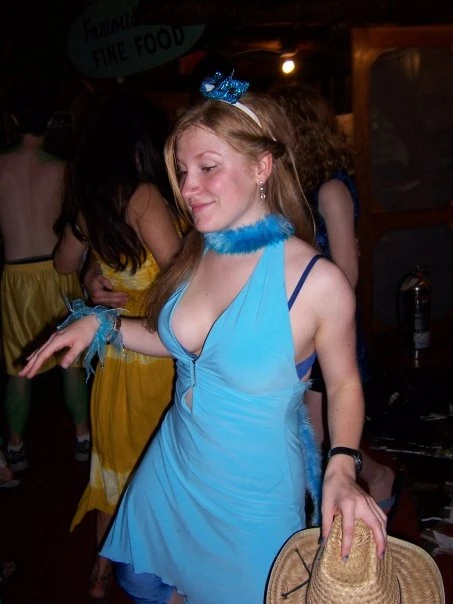
(College “I’m dressed as a fairy holding the ‘make out’ hat” and “this photo is actually super flattering” phase)
Yet I dug up one from another angle in which I appear a bit less flat:

(Yes, I’m kissing someone, not a phase.)

(College “I’m a crunchy hippy” phase)
———-
Enter “success”
In the fall of 2009 I finally achieved the momentum I needed on my low fat, low calorie, vegetarian diet, 90-minute-sprint-workouts-every-day regimen to shrink down to, at my lowest, I think I was probably around 105 pounds. I bounced back up to 115 for the next few years but I still wore size zero, 25 inch waist pants.
In this time period, I experienced:
-the complete cessation and continued absence of anything resembling a sex drive
-an vagina that was, all of the time, as dry as Oscar Wilde (if not more so-if such a thing is possible)
-a completely absent menstrual cycle
-cystic acne
-constant hunger (though I did not know it at the time since I had yet to experience the real cycle of intuitive eating yet)
These five bullet points might not look like much – but when you’re a woman who prided herself on her voracious sex drive and then it completely vanished, and you became infertile, and had acne… the thing was, I always suspected that my weight was to blame for my acne, at least in part, but I always thought it still worth the trade off. I’d rather have acne and be thin than be fat with clear skin.
Sad.
This is what I looked like in this time period:

(“I cover my face because the sun burns my acne” phase)

(“I have eight pack abs, so what, b*tches?” phase)

(“Thigh gap!” phase)

(“Holy crap I’m so comfortable in this tiny body please don’t take it away” phase)
———-
Lots of women probably menstruate at the size I was in the photos above. They probably had sex drives. I did not. All I had managed was to salvage my skin, mostly by reducing the fiber and protein contents of my diet, as well as by adding a topical probiotic to my daily regimen and ceasing to use conventional soaps and such. I had also managed to ovulate a few times, mostly by radically reducing stress or by having a particularly potent sexual encounter, but I did not have a true menstrual cycle, not by a long shot.
I also ate paleo the whole time, so anyone who says all you need to be healthy is a paleo diet is woefully uninformed.
———-
Enter “failure”
Then came a time in which I prioritized my work and energy over everything else, and was extraordinarily stressed out. I gained weight. fast. And surprise of surprises, I menstruated. (Literally, it smacked me right out of the blue.) My sex drive had steadily increased up until that day, and has remained not just “oh thank god sex doesn’t disgust me anymore” or “well sure I’ll kiss you I guess” but “holy crap I want to do it now” since then. I have continued to cycle since. And my skin has cleared, almost entirely (to be fair: my stress has also been radically reduced), and I have, to my mingled dismay/resignation/fear/acceptance, continued to gain weight.
This is what a Stefani that can menstruate looks like:

(“I’m such a big deal I do photoshoots and holy crap I’ve got hips” phase)

(“Holy crap back fat stomach fat” phase)

(“Bear in mind that the camera on my phone elongates and I’m not nearly this tall or slim” phase)
If you want to see a video of me partner dancing in a body that menstruates (which is, still, a size or two smaller than I am now, I am more than happy to invite you to do so, here).
———–
Looking at these photos, you might hardly see a difference. So what, you say. “She’s not overweight.”
No, of course not. I agree. I mean — there is definitely a difference, and just about everybody in my life has remarked upon it. My thighs are about 3 inches thicker, each. My face “fuller.” My abs, gone. My periods, pain free, and quite short (thanks to paleo!). I used to be a size 26 jean, and last night I wore a 30. I can no longer wear any outfit with carefree abandon — I now have to worry about placement and what the most flattering cut is and how to handle the parts of my that jiggle.
Some people say I look better. I don’t know. Can I compare? I don’t know. I know I look different, and that’s all that has mattered, and all that made this, while on one hand the best thing in my life, also, on the other hand, one of the harder things I have done (at least in 2014 🙂 ).
It’s been a small difference, but I had to read my own writing, and reach out to others for reassurance, and make a deliberate effort to arm myself against the tides of psychological baggage that tells me putting on weight makes me a failure, marks me as lazy, and renders me unfit for love. I believe so strongly in allegiance to our natural bodies, but that does not mean that I still did/do not have to fight for it on my “bad” days. Only because the gains I have had have been so great — I’m never giving up sex again — and because I have such loving, supportive people in my life, and because I’m currently finishing editing a book all about self-love, was I able to fall asleep peacefully at night rather than in a fit of frustrated, frightened tears.
Our society makes it hard. Even at my own relatively small weight gain and size. It makes it hard to “lose ground.” It makes it hard to “backslide.” But that doesn’t mean we give up. We remind ourselves of our own inherent worth, and we push through, and we change the face of womanhood one woman at a time.
I am no longer a fitness champion. I can no longer compare myself to Victoria’s Secret models. But I am different. I’m a new kind of sexy (more about which in coming days). I am me. And I am happy, and fertile, and healthy, and alive.
Hell. Yes.
by Stefani Ruper | Jul 22, 2013 | Blog, Body, Fertility, Fitness, Hormones, HPA axis, Hypothalamic Amenorrhea, Stress, Thyroid |
Far back in the very beginning weeks of this blog, I wrote a long series of articles on the sources of infertility. In terms of the kinds of infertility caused by diet and lifestyle, there are two primary categories: PCOS and Hypothalamic Amenorrhea. Long time readers of this blog know that I believe the relationship between these two disorders is much more complicated than regular doctors and medicine would have us believe. Nonetheless, while I was writing about PCOS and HA (read more about HA here and here and here), I promised to write a post on how to overcome HA.
I never did.
The reason I didn’t write it is because the answer is both way too complex and way too simple. I couldn’t come up with anything coherent to say.
Hypothalamic Amenhorrhea is the fancy way of saying “stress-induced loss of menstruation.” The hypothalamus is the part of the brain that determines if you are in a safe enough environment to bear children. If your body receives signals that you are not “safe” enough, then your hormone production will decrease and you will stop menstruating. You may also suffer symptoms of low libido, depression, anxiety, insomnia, acne, and fatigue.
“Safe” means both physiologically and psychologically. Mental stress can hurt your fertility just as much as physical stress. Unfortunately, these two stressors commonly occur in women today, and commonly in paleo dieters. Mental stress comes from pressure and ambition and work and life as well as body image issues, low-self-esteem, and disordered eating. Physical stress comes from low body fat levels, rapid fat loss, excessive fat loss, fasting, over-exercising, under-sleeping, and under-eating. It’s no wonder that so many women struggle with this.

Estrogen, progesterone, LH and FSH — all female hormones — decrease with hypothalamic stress. LH and FSH come directly from the pituitary and fall off the wagon, and then estrogen and progesterone, which take their cues largely from LH and FSH, fall off of it, too.
Can it be overcome?
Sure.
Is it easy?
Not always.
——————–
The thing about HA is that its severity and “cure” are different for each woman. The trick is to address all of the kinds of stress that play a role in HA, and to focus on the type of stress that caused your problem in the first place.
For example: say you recently dropped from 130 to 110 pounds. The primary problem — the thing that if it looks like a duck and quacks like a duck, it’s a duck, so stop fighting the reality of your weight loss — is that you lost too much weight too fast. Your body couldn’t keep up with your changing leptin levels. And you likely underate calories and gave your body starvation signals while you were losing. So that needs to take precedence. You also, however, exercise a fair bit and have a fairly stressful life. To that end, you should also reduce your exercise, work on your priorities and your stress level, and be sure to eat as much as you need to. Address all of the ways in which you can increase your body’s detection of “safety.” Focus on perhaps gaining a little bit of weight back, however, since that was your primary “problem.” The faster you can convince your body you are no longer starving, the faster you’ll regain hormone balance and fertility.
Other women, on the other hand, might have to focus on stress, or might have to give up marathoning for a while.
HA is all about convincing your body that it’s no longer in danger. It doesn’t need to stress. It doesn’t need to shut down hormone production to prevent a poorly timed pregnancy. So you have got to nourish it as best you can. Err on the side of over versus under eating. Dial down your exercise — particularly the sprint based kind — and do only what feels comfortable. Stop pushing through being so tired. Don’t wake up in the morning to an alarm after a short night’s sleep to go for a run. Be sure to eat plenty of carbohydrates — at very minimum 100 grams of carbohydrate a day — and make sure to eat even more if you are an athlete. Learn to move more slowly, to eat more gently, to be less hard on yourself. Relax, eat, relax, eat, relax, eat, repeat. Don’t eat garbage– no way! Some women do, and find that their fertility comes back. But go wild with your diet, and eat as much as you are craving. Your body has been starved, and it’s important to respond to hunger signals when you have them. That is, if you want your fertility back.
To that end, there’s a simple answer to HA:
-Eat more. Relax more. Repeat.
On top of that, we can get more specific:
-Focus on nutrient-rich foods that support healthy hormone production. Liver, egg yolks, other organ meats, bone broth, leafy greens, fruits, and vegetables are all great.
-Make sure to eat plenty of fat. At minimum 40 grams a day. This amounts to approximately three tablespoons of your favorite paleo oil (such as coconut oil) — one for each meal. Including saturated fat is particularly helpful since it is the backbone of hormone production.
-Make sure to eat plenty of carbohydrates. Your body can think it’s starving if it doesn’t get enough for a significant period of time. Eat at least one piece of fruit or serving of starchy carbs with every meal. Make sure to do more on active days.
-Eat when you are hungry. Do not go hungry. Ever.
-Only exercise when you feel energetic and excited to do so, and refuel appropriately afterward.
-Do not sprint more than a couple of times a week.
-Consider eating a fuck ton of calories. Many women have spent ages on different forums learning about what works, and debating how many calories should be eaten at any given point in time. Some argue you need as many as 3000 calories a day to recover. Others assert 2000. I wouldn’t go crazy, but consider the fact that there’s a good chance you are undereating relative to your needs.
-Consider weight gain. Anywhere from 1 pound to 10 might be necessary, or 30, depending on where you are. How much did you weigh when you stopped menstruating? Is it much more than where you are now? How much more? What else was going on in your life? You may need to close the gap a bit between where you are now and where you stopped menstruating in order to do so again. Each woman’s body is different and requires a different level of fat to feel safe and be fertile.
-Sleep as much as possible. 9 hours a night!
-Consider supplementation. Magnesium supports hormone production. Calcium is helpful with the magneisum. Take the magnesium and calcium in a 1:1 or 1:2 (at most) ratio. Vitamin D can support functions with magnesium and calcium. Fermented cod liver oil will never hurt.
—————–
Which is all that I’ve got. I know it’s a lot and also a little at the same time. Hypothalamic amenorrhea is all about you and your body and your own particular needs. You’ve got to think deeply about the kinds of stress you might be dealing with, and then go ahead and rectify it.
And then give it time.
It takes time to recover from this sort of thing. Hormones don’t leap ahead of us, they follow behind, peaking around all of the corners, making sure it’s safe before they come out and play. I can say, however, that your recovery will be faster the more you nourish yourself, the more you eat, and the more you relax. You can go more slowly if you are fearful of the process. This is what I did. And it’s good — the body learns to adjust to new leptin levels over itme. But know that it takes longer the more slowly and cautiously you move forward with your hypothalamus.
I highly recommend checking out the Fertile Thoughts forum on hypothalamic amenorrhea. It contains 108,000 posts and counting. Women all across the world come to this forum to share their experiences with HA and infertility. Definitely worth the read if you’re interested in HA at all.

by Stefani Ruper | Mar 19, 2013 | Blog, Body, Fertility, Hormones, HPA axis, Hypothalamic Amenorrhea, Stress |
One of the biggest hormone problems that plagues women is having low progesterone levels.
In some cases, this is somewhat natural: it happens during menopause, perimenopause and in periods of hormonal flux.
Nonetheless: a diagnosis of low progesterone is fairly common even among women of reproductive age. This occurs to two main groups of women: first, the estrogen dominant, and secondly, the stressed.
Low progesterone and estrogen dominance
Estrogen dominance is the condition of having too much estrogen relative to progesterone.
Symptoms of estrogen dominance include being overweight, PMS, menstrual cramps, decreased libido, bloating, breast swelling and tenderness, fibrocystic breasts, endometriosis, PMS-related headaches, mood swings, and thyroid malfunction.
You can become estrogen dominant if progesterone levels fall too low – yet you can also experience symptoms of low progesterone if estrogen levels become too high. Phytoestrogens in the diet, birth control pills, inflammation, and a sedentary lifestyle are a few of the many ways to cause unnaturally high estrogen levels. Check out this post on estrogen dominance for more.
Low progesterone and pregnenolone steal
Hormones are produced in a cascade. I like to think of the system like a set of dominoes: the hypothalamus (a part of the brain) tells certain glands like the pituitary and adrenal glands how hard to work, then their own hormones go on to signal to other hormones, and on and on. The dominoes fall in a perfectly regimented pattern if all of the surrounding dominoes do their jobs, too.
Unfortunately, when things go wrong early on in the hormone production process, there can be many significant problems down the line.
Progesterone is affected by one such problem.
Progesterone is synthesized fairly early in the hormonal cascade, and it’s activity is highly influenced by the level of stress–either physical or emotional–a woman is experiencing. I wrote about this in a post about a year ago, titled “The HPA axis: what is pregnenolone steal?”
Another name for pregnenolone steal is as progesterone steal.
Pregnenolone is the primary “precursor” hormone. It sits at the top of the domino chain and is directed to be used by the body however it sees fit. The primary decision the body makes with pregnenolone is whether it wants to make sex hormones like progesterone or stress hormones like cortisol.
If a woman is stressed, her body “steals” the pregnenolone and uses it for stress hormone production instead of progesterone production.This means that other female hormones also take a hit — accounting for why some women have low hormone levels across the board — but progesterone is one of the hardest hit. If a woman has low progesterone in her labs, it’s a pretty good bet that her body is using her resources to produce cortisol rather than progesterone.
For this reason, reducing stress is actually the only clinically well-known way to increase progesterone production.
This isn’t an easy answer. Stress reduction takes real work. We cannot just promise to sleep more or to spend more time with ourselves or our families, and then let these promises drift away as life marches on. Instead, we have to make concrete changes to our schedules, to our jobs, to our relationships, to our feelings about our existence. Often, psychologists can be uniquely helpful, as can group involvement, friendship, spiritual communities, and yoga and meditation.
Stress levels can also be reduced by making sure to eat a nourishing diet that doesn’t have any kind of a starvation component. Physical stress is nearly as important to address for this as emotional stress. Eat when you are hungry, and do your absolute best to assure your hypothalamus that it has nothing to stress about.
Symptoms of low progesterone (without estrogen dominance) include:
classic hypothalamic amenorrheic symptoms: irregular cycles, infertility, anxiety, low libido.
If you reduce your stress levels, you may see these problems slowly tick away. Perhaps most delightfully, progesterone is well-known as carrying with it significant libido-enhancing power. Reduce your stress, and your sex life make thank you, too.
This is a common theme for women’s health. Stress can have a very significant impact on us — far more so than it does on men.
Why? It is actually an evolutionary adaptation. The female body needs to protect itself against becoming pregnant at a time of famine, war, or other kind of life-threatening strife. The way it does so is by shutting down hormone production whenever stress appears to be too strong or chronic. Stress indicates that it may not be a “safe” enough environment to be pregnant.
Hormones may be a complex and challenging part of being a woman – but they can also be a rewarding one. The trick is simply to learn how to raise a white flag and stop being in a state of constant warfare against the body – and instead start practicing how to live in harmonious dialogue. I talk in great depth about how to do so in my best-seller – Sexy by Nature – which you can take a look at at Amazon, here. It was a real adventure, but I finally learned how to do it (and get my progesterone levels back up!), and you most certainly can, too.
What about you? Are you low in progesterone? What success have you had working with it?